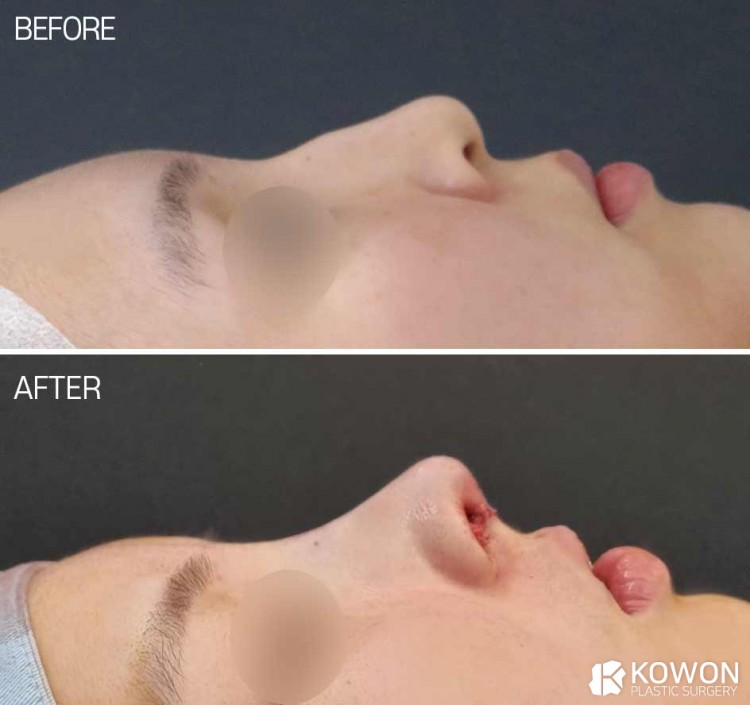
This rhinoplasty case demonstrates how low hump nose correction, alar retraction correction, and nostril show reduction can improve overall facial balance.
The patient had:
• Low hump nose
• Excess nostril show
• Retracted alar rims
• Short and upturned nasal appearance
Structural rhinoplasty with alar rim correction was performed to improve nasal tip projection, nostril exposure, and profile harmony.
Performed by Dr. Kim Hyung Taek at KOWON Plastic Surgery Seoul, Korea.
What is alar retraction?
Alar retraction refers to a condition where the outer nostril rim is pulled upward, causing excessive nostril show from the front view. It is different from a simple upturned nose because the alar rim itself is elevated.
Can nostril show be corrected with rhinoplasty?
Yes. Nostril show can often be improved through structural rhinoplasty techniques such as tip support grafting, tip repositioning, and alar rim correction.
What is alar rim correction?
Alar rim correction is a procedure used to lower and support the nostril rim when excessive nostril exposure is present. Structural cartilage grafting is often required for long-term stability.
Is implant-free rhinoplasty possible for alar retraction correction?
Depending on the nasal structure and skin condition, implant-free rhinoplasty may be possible using autologous cartilage techniques. The surgical method should be customized to the patient’s anatomy.
Why does a low hump nose sometimes look flat?
In some patients, the nasal bridge is generally low while only the hump area protrudes slightly. This can create an uneven bridge contour and reduced facial definition.
This real before and after rhinoplasty case at KOWON Plastic Surgery Seoul demonstrates how low hump nose correction, alar retraction correction, nostril show reduction, and natural structural rhinoplasty in Korea can improve overall facial balance and nasal definition.
These photos were taken immediately after surgery, allowing the early structural changes to be seen before significant swelling develops.
Hello, I am Dr. Kim Hyung Taek of KOWON Plastic Surgery, a clinic specializing in rhinoplasty in Korea, revision rhinoplasty, rib cartilage rhinoplasty, upturned nose correction, alar rim correction, and natural facial harmony design for international patients.
This patient presented with a combination of concerns involving both the nasal bridge and nostril structure.
The bridge showed a relatively low hump nose appearance, where the middle portion of the bridge protruded slightly while the overall bridge height remained low.
At the same time, the outer alar rims were retracted upward, creating excessive nostril show from the frontal view. This created a short and somewhat awkward nasal appearance often described as an “upturned nose” appearance.
However, this condition differs from a simple upturned nasal tip.
In this patient, the alar rims themselves were elevated and rolled upward, exposing the nostrils outward from the front view. Because of this, the nose appeared shorter, less refined, and structurally unbalanced.
In addition, because the bridge itself lacked projection, the hump area appeared relatively more prominent, creating an uneven dorsal contour and reduced facial definition.
Why Structural Planning Is Important
In cases like this, simply shaving the hump, raising the bridge, or narrowing the nostrils alone is usually not enough.
It is important to consider the relationship between:
- Nasal bridge
- Nasal tip
- Columella
- Alar rims
- Nostril exposure
- Facial balance
and reconstruct the overall nasal framework together.
Surgical Strategy
The hump area was conservatively refined to create a smoother and more natural bridge contour.
Rather than simply making the bridge higher, the goal was to create a bridge line that connects naturally into the tip while maintaining harmony with the face.
The nasal tip was corrected using:
- Tip cartilage repositioning
- Tip cartilage suturing
- Structural cartilage grafting using autologous cartilage
These techniques allowed the tip to become more refined and naturally projected while maintaining stable support.
A structural support graft was placed between the tip cartilages to prevent postoperative loss of projection and help maintain long-term tip stability.
Alar Retraction Correction (Nostril Show Correction)
In patients like this, where the outer alar rims are elevated and excessive nostril show is present, lowering the tip alone is often insufficient.
For this reason, alar rim correction (alar retraction correction) was performed together.
The purpose of this procedure is not simply to “cover” the nostrils.
Instead, it is designed to restore balance between:
- The alar rims
- Columella
- Nasal tip
- Nostril shape
By improving these relationships, excessive nostril exposure from the front view can be reduced while creating a softer and more refined appearance.
In this patient, structural cartilage grafting was also used to support the alar rims and help prevent recurrent upward retraction over time.
This type of structural reinforcement is important for achieving more stable long-term results.
Profile Balance & Nasolabial Angle
The columella, nasolabial angle, and philtrum line were also carefully adjusted to improve the transition between the nose and upper lip.
As a result:
- The mouth appeared less protrusive
- The side profile looked softer and more balanced
- The facial impression became more elegant and refined
Current Korean Rhinoplasty Trend
Modern Korean rhinoplasty trends are moving away from excessively high or artificial-looking noses.
Today, many patients seek a result that is:
- Natural
- Refined
- Balanced
- Elegant
- Detailed without looking overdone
This is often described as a natural glam rhinoplasty style.
Especially in patients with alar retraction or nostril show, simply making the nose longer or higher is not enough.
The amount of nostril exposure and alar rim balance must also be considered to create a more complete and natural-looking result.
For this patient, surgery was carefully planned to create a refined and elegant nose line while preserving overall facial harmony.
Immediately After Surgery
Immediately after surgery is the stage before major swelling develops, so the bridge line, tip contour, nostril shape, and alar rim structure can often be seen more clearly.
At KOWON Plastic Surgery Gangnam Seoul, we focus not only on increasing height, but also on structural balance, facial harmony, and long-term stability.
As healing progresses, swelling decreases and tissues stabilize, allowing the final result to become softer and more natural over time.
Results of alar retraction correction, low hump nose rhinoplasty, and nostril show correction in Korea vary depending on anatomy, skin thickness, and healing response.
Final results are evaluated after sufficient recovery time.
👨⚕️ Dr. Kim Hyung Taek
Rhinoplasty Specialist | KOWON Plastic Surgery Seoul• 20+ years of rhinoplasty experience
• Specialized in:
– Revision rhinoplasty
– Rib cartilage rhinoplasty
– Upturned nose correction
– Alar retraction correction
– Natural facial harmony rhinoplastyDr. Kim focuses on structural rhinoplasty techniques designed to create natural, stable, and balanced results for each patient.
📍 KOWON Plastic Surgery, Gangnam Seoul
📲 Official WhatsApp Consultation Available