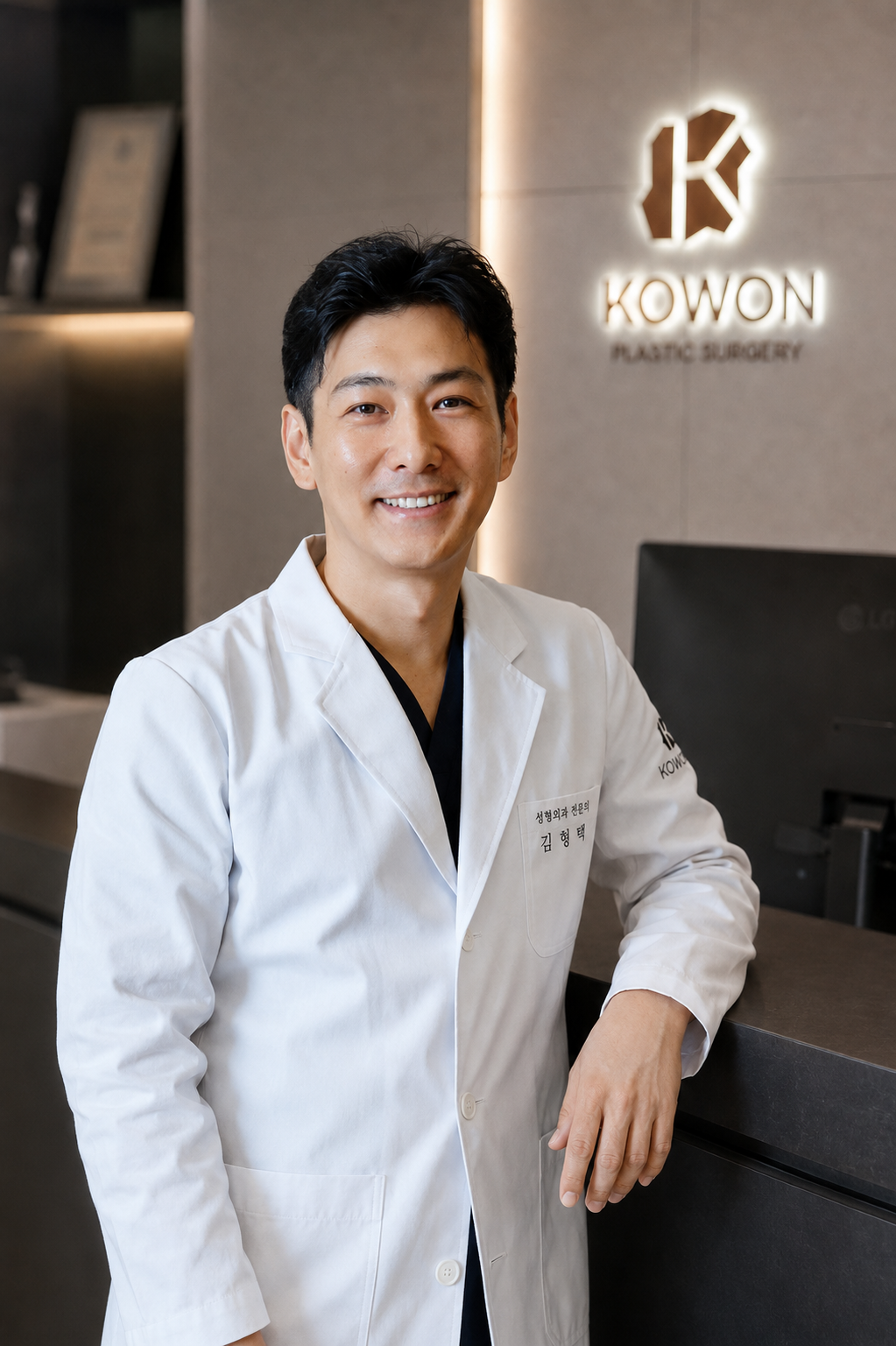
Rhinoplasty Specialist at KOWON Plastic Surgery
Hello, I’m Dr. Kim Hyung Taek of KOWON Plastic Surgery
Written on April 24, 2026 by Dr. Kim Hyung Taek
Hello, I’m Dr. Kim Hyung Taek, a board-certified plastic surgeon in Seoul and the director of KOWON Plastic Surgery. For more than 20 years, I have focused on rhinoplasty, including primary rhinoplasty, revision rhinoplasty, and rib cartilage rhinoplasty, while continuing to study how nasal surgery can be planned in a way that is both natural and structurally stable over time.
As the years go by, one thing becomes even clearer to me:
even noses that may look similar at first glance often create very different impressions for very different reasons.
Some patients are concerned about a low bridge.
Some feel that their nasal tip lacks support.
Others come in after previous surgery feeling that their nose no longer looks natural or balanced.
On the surface, these cases may seem similar, but in reality, each one usually has a different structure and a different reason behind it.
Over the years, I have personally operated on a wide range of cases—from primary rhinoplasty and revision rhinoplasty to rib cartilage rhinoplasty, removal of foreign materials previously inserted into the nose, and surgery for patients who cannot use silicone and may need an alternative approach using their own cartilage.
The more experience I gain, the more strongly I feel that the most important question is not simply how much higher the nose becomes, but how naturally that change fits the face and whether it can remain stable without strain as time passes.
That is why I do not look at only the bridge or the tip separately.
When I evaluate a nose, I also look at the overall facial impression, the flow of the profile, the support of the tip, the columella, the nasolabial angle, and how all of these elements work together within the balance of the face.
There are many nose shapes that may be considered attractive or trendy, but whether a certain shape truly suits an individual face is a different matter.
Why does one nose shape look natural on one person but not on another?
Which part should be adjusted so that the nose can blend more harmoniously with the patient’s own features?
These are the questions I continue to ask in consultation and in surgical planning.
This becomes even more important in revision rhinoplasty or in cases that require stronger structural support.
In those situations, I believe it is more important to first understand
why the nose looks the way it does now
and
where stability needs to be rebuilt,
rather than focusing only on the visible line.
That is also why I created this blog.
Rhinoplasty is not a procedure that can be fully understood from a few photos alone.
There are many details that are difficult to organize through a short consultation explanation only.
Through this space, I want to explain more clearly and calmly how nasal changes are planned, why certain surgical decisions are made, and what structural points matter most—based on the real cases I have personally operated on, immediate post-op photos, and the questions patients ask most often during consultation.
At KOWON Plastic Surgery, I believe it is important for the surgeon to remain closely involved throughout the entire process, from consultation to surgery and follow-up.
Rather than showing only the result, I prefer to explain what kind of structural change was made, what kind of support was needed, and why a certain direction was chosen as the more natural and balanced option for that individual patient.
I hope this blog can become a more realistic and trustworthy point of reference for those considering rhinoplasty in Korea, especially for patients who want to understand not only how the nose may look, but also how and why that change is created.
Dr. Kim Hyung Taek
Board-Certified Plastic Surgeon
20+ years focused on rhinoplasty
Director of KOWON Plastic Surgery, Seoul
Former Director of Yonsei O&Young Plastic Surgery
Former Adjunct Professor, Department of Plastic Surgery, Sungkyunkwan University School of Medicine
Primary Rhinoplasty / Revision Rhinoplasty / Rib Cartilage Rhinoplasty